



I spent four years working at the San Antonio Food Bank , starting in 2019. My first year, I was learning the ropes, getting my bearings, and stretching my capacity. What I imagined, getting my foundation set for my second year and then expanding my skillset and pushing forward in the organization, didn’t go as planned.
It was January 2020 when we started hearing the murmurs, the overseas chatter, then the quarantined cruise ship, then the mall outbreak, then… shutdown. I was in the hospital in March 2020, welcoming our second daughter (shout-out to my wife, Damaris, for her strength and resilience in bringing Ruth into the world! I take no credit). The world I left on March 4th, and the one I re-entered with a newborn on March 5th, would be a sign of things to come. I walked out of the hospital to get our car from the medical center parking garage. When I walked back in, I was confronted by a hospital security guard and asked questions about my symptoms and how I was feeling, who I was, and where I was going. The realization that this would be the new normal had not quite struck me yet, but the interaction had left me with a heaviness in my gut.
As my wife and I spent that week in our own mini newborn “lockdown”, we felt the tide shift as our city went from business as usual to an official quarantine lockdown. My colleagues at the San Antonio Food Bank were not only deemed essential workers, but we were also asked to keep coming into the office. I was asked to cut my parental leave short and work remotely for that second week of Ruth’s life. I started messaging with our staff daily - sometimes multiple times a day - to make critical updates and ensure our food bank websites were up-to-date with health information and … more importantly … food distribution information.
Suddenly, we were being asked to serve 120,000 of our neighbors every week… DOUBLE the normal need… overnight.
It was a seismic, tectonic shift. It showed how fragile our community’s systems, capacity, and welfare really were. How quickly a family could go from sharing a meal at their dinner table, to running out of gas in a parking lot waiting for food distribution groceries. It clarified for me that food was foundational. Access to it was the bedrock of a stable society, and, as we witnessed society shutter in crisis, it was a foundation we would have to fight to save… together.
I recently reached out to my former leader and someone I consider a mentor, Michael Guerra , the Chief Philanthropy Officer at the San Antonio Food Bank. We have continued conversations about the cultural and equity landscape in San Antonio (and the surrounding counties and communities they serve) even as I have moved into a different role at SAMMinistries over the past (almost) three years. We talked about the importance of food, and he relayed a powerful quote from their President and CEO, Eric Cooper :
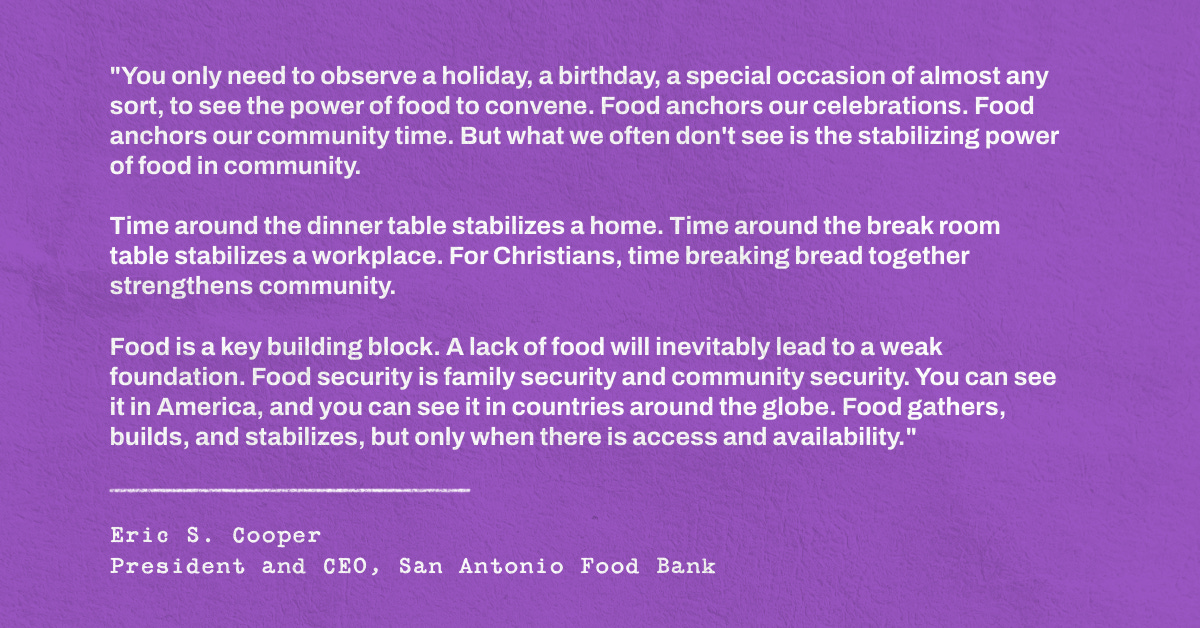
“You only need to observe a holiday, a birthday, a special occasion of almost any sort, to see the power of food to convene. Food anchors our celebrations. Food anchors our community time. But what we often don’t see is the stabilizing power of food in community.
Time around the dinner table stabilizes a home. Time around the break room table stabilizes a workplace. For Christians, time breaking bread together strengthens community.
Food is a key building block. A lack of food will inevitably lead to a weak foundation. Food security is family security and community security. You can see it in America, and you can see it in countries around the globe. Food gathers, builds, and stabilizes, but only when there is access and availability.”
Eric S. Cooper, President and CEO, San Antonio Food Bank
Food is foundational to communities that thrive. When the pantry is bare, the dinner table collects dust. And the dinner table is where community happens. One of my favorite quotes, one that I have immortalized as a sticker on my laptop, says:
“If you are more fortunate than others, build a longer table, not a taller fence.”
This quote has stayed with me for a long time. The dinner table is not just a family setting; it is a hub for community activity and an opportunity to grow belonging and solidarity for us as people. I recall countless church potlucks and fellowship halls growing up in a Southern Baptist church in Illinois1. We crave community, whether at the dinner table at home or in breakrooms, halls, temples, or chambers. The idea of dinner table fellowship is creating spaces for community anywhere. And building a longer table brings more people into that sense of belonging.
❤️ So, I ask you today as we look to this precious holiday season: where is your heart calling you?
These days, filled with the dissonance of both hope and tensions, how can you extend your dinner table beyond your circle of family and friends? If people feel they belong at the table, they will see the opportunities we can all share: to secure food for today, build homes for tomorrow, and open doors to brighter futures.
🤝 Getting Involved
If you would like to prepare the larger table, visit safoodbank.org and see how you can help a neighbor in need. 🍎🍎
You can also learn more and connect by watching stories that help us all meet neighbors where they are: https://youtube.com/playlist?list=PLIMJilAoznPv-bvS_PIZbdCFuAsRo889C&si=1hMEEXWiFtXWlgh6.
If you are drawn to housing solutions and opening doors to brighter futures, you can follow the work we do at SAMMinistries and connect with the local network of nonprofits working together to ensure everyone has a place to call home with Close to Home.
Thanks,
Rob
Yes, I’m aware that doesn’t sound very Southern.